


The New York Times bestseller, and one of the most talked about books of the year, Nickel and Dimed has already become a classic of undercover reportage. Millions of Americans work for poverty-level wages, and one day Barbara Ehrenreich decided to join them. She was inspired in part by the rhetoric surrounding welfare reform, which promised that any job equals a better life. But how can anyone survive, let alone prosper, on $6 to $7 an hour? To find out, Ehrenreich moved from Florida to Maine to Minnesota, taking the cheapest lodgings available and accepting work as a waitress, hotel maid, house cleaner, nursing-home aide, and Wal-Mart salesperson. She soon discovered that even the "lowliest" occupations require exhausting mental and physical efforts. And one job is not enough; you need at least two if you intend to live indoors. Nickel and Dimed reveals low-wage America in all its tenacity, anxiety, and surprising generosity -- a land of Big Boxes, fast food, and a thousand desperate strategies for survival. Instantly acclaimed for its insight, humor, and passion, this book is changing the way America perceives its working poor.
2002
1 pages

Women have always been healers, and medicine has always been an arena of struggle between female practitioners and male professionals. This pamphlet explores two important phases in the male takeover of health care: the suppression of witches in medieval Europe and the rise of the male medical profession in the United States. The authors conclude that despite efforts to exclude them, the resurgence of women as healers should be a long-range goal of the women’s movement.
1993
48 pages
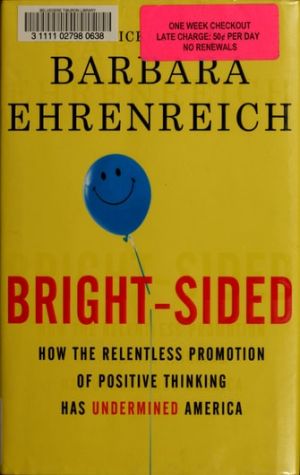
A sharp-witted knockdown of America's love affair with positive thinking and an urgent call for a new commitment to realismAmericans are a "positive" people—cheerful, optimistic, and upbeat: this is our reputation as well as our self-image. But more than a temperament, being positive, we are told, is the key to success and prosperity. In this utterly original take on the American frame of mind, Barbara Ehrenreich traces the strange career of our sunny outlook from its origins as a marginal nineteenth-century healing technique to its enshrinement as a dominant, almost mandatory, cultural attitude. Evangelical mega-churches preach the good news that you only have to want something to get it, because God wants to "prosper" you. The medical profession prescribes positive thinking for its presumed health benefits. Academia has made room for new departments of "positive psychology" and the "science of happiness." Nowhere, though, has bright-siding taken firmer root than within the business community, where, as Ehrenreich shows, the refusal even to consider negative outcomes—like mortgage defaults—contributed directly to the current economic crisis. With the mythbusting powers for which she is acclaimed, Ehrenreich exposes the downside of America's penchant for positive thinking: On a personal level, it leads to self-blame and a morbid preoccupation with stamping out "negative" thoughts. On a national level, it's brought us an era of irrational optimism resulting in disaster. This is Ehrenreich at her provocative best—poking holes in conventional wisdom and faux science, and ending with a call for existential clarity and courage.
2009
206 pages