
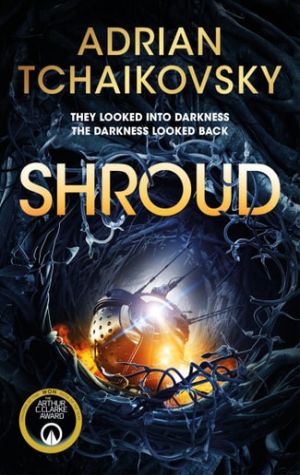
After two scientists crash on a hostile moon, they must use every tool at their disposal to survive. Shroud is a tense, atmospheric voyage into the unknown from sci-fi master and Arthur C. Clarke Award Winner Adrian Tchaikovsky. They looked into the darkness and the darkness looked back... New planets are fair game to asset strippers and interplanetary opportunists--and a commercial mission to a distant star system discovers a moon that is pitch black, but alive with radio activity. Its high-gravity, high-pressure, zero-oxygen environment is anathema to human life, but ripe for exploitation. They named it Shroud. Under no circumstances should a human end up on Shroud's inhospitable surface. Except a catastrophic accident sees Juna Ceelander and Mai Ste Etienne doing just that. Forced to stage an emergency landing, in a small, barely adequate vehicle, they are unable to contact their ship and are running out of time. What follows is a gruelling journey across land, sea and air. During this time, Juna and Mai begin to understand Shroud's dominant species. It also begins to understand them. If they escape Shroud, they'll face a crew only interested in profiteering from this extraordinary world. They'll somehow have to explain the impossible and translate the incredible. That is, if they make it back at all.
The first portion of the book is the human setup. A planet that is entirely dark but on which has been found life. A human society that’s become entirely focused on business, productivity and the most awful aspects of middle-management that you’ve ever experienced. A frustrated protagonist whose duty seems to be coordinating a spaceship crew that’s essentially an office of staff that don’t get on with each other.
It’s wryly humorous with a strong undercurrent of mystery. The only video of the planet that manages to reach the ship reminded me of ‘found-footage horror’ in how vague it is, with just enough going on to inform the reader that this place is Not Pleasant At All.
Then suddenly our protagonist finds herself on the surface. Possibly. She’s not an astronaut at all, not even a scientist. There’s no way to communicate past the atmosphere, and no indicator of any help coming. Her surviving colleagues still don’t get on. And there’s alien life coming by to see what all the noise is about.
To my surprise and pleasure, the book then shifts to the ‘alien’ perspective - and it’s amazing! No spoilers, but this is a human writer depicting a very non-human life-form about as perfectly as can be. They don’t see like we do, communicate or understand, but they’re far from stupid. In fact, they seem to be far smarter than the human society that’s inadvertently made first contact, and it’s fascinating to imagine how such interaction would go.
Because of course, the planet is not at all friendly to humans, and with limited oxygen and food, what are those two-leggers to do? And whose side will the reader end up on?
While ‘Alien Clay’ hasn’t quite been ousted from my Favourites podium just yet (effusive review on my blog), ‘Shroud’ is a close second. The skill at which Tchaikovsky draws us in with relatable characters - both human and alien - is incredible, and I genuinely did not know what was going to happen from one moment to the next. Everything makes sense in context, and the ‘science’ isn’t too dense that I ever felt lost.
I have never read anything like this, and the sheer atmosphere of it will stay with me for a long time. Relevant twenty-first-century science-fiction at its absolute best.
I was kindly sent an early copy of this book by the publisher, but the above opinions are entirely my own.